Guide
Finger Foods for 8-Month-Old Babies (Safe Choices)
By Dr. Sarah Mitchell, Paediatric Nutrition Specialist · Updated 2026-03-25
This post contains affiliate links. We may earn a commission at no extra cost to you. This article is for informational purposes only -- consult your paediatrician for personalised feeding advice.
Finger Foods for 8-Month-Old Babies (Safe Choices)
By Dr. Sarah Mitchell, Paediatric Nutrition Specialist | Last updated March 2026
At 8 months, most babies have developed the palmar grasp, sitting balance, and chewing movements needed to explore finger foods safely. The key principles: foods must be soft enough to squash between your thumb and forefinger with light pressure, served in pieces large enough to grasp but not choke on, and introduced alongside continued breast milk or formula. This guide covers what's safe, what to avoid, and how to prepare each food.
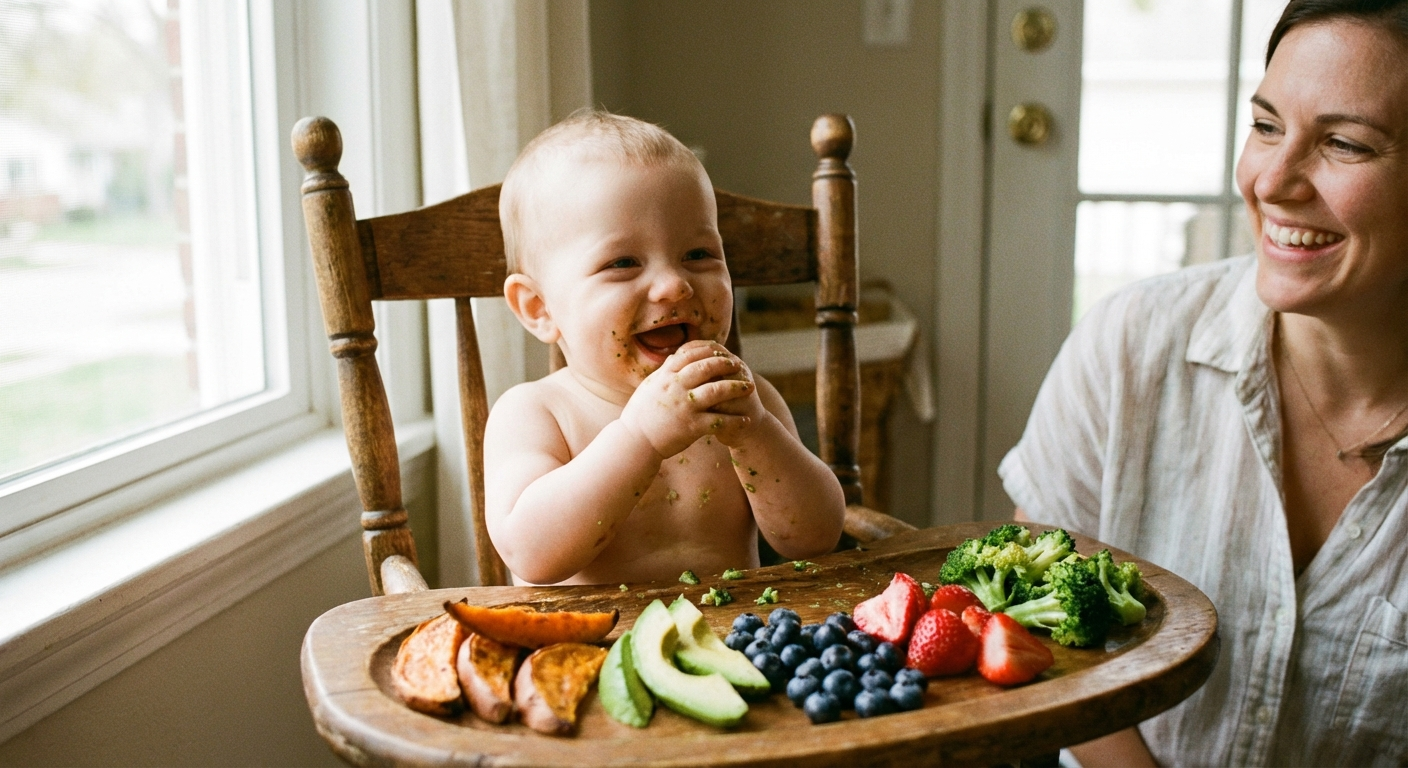
Table of Contents
- Developmental Readiness at 8 Months
- The Squish Test: Texture Guideline
- Safe Finger Foods by Category
- Foods to Avoid at 8 Months
- How to Prepare Each Food
- Best Baby Feeding Products
- Frequently Asked Questions
- Sources & Methodology
Developmental Readiness at 8 Months
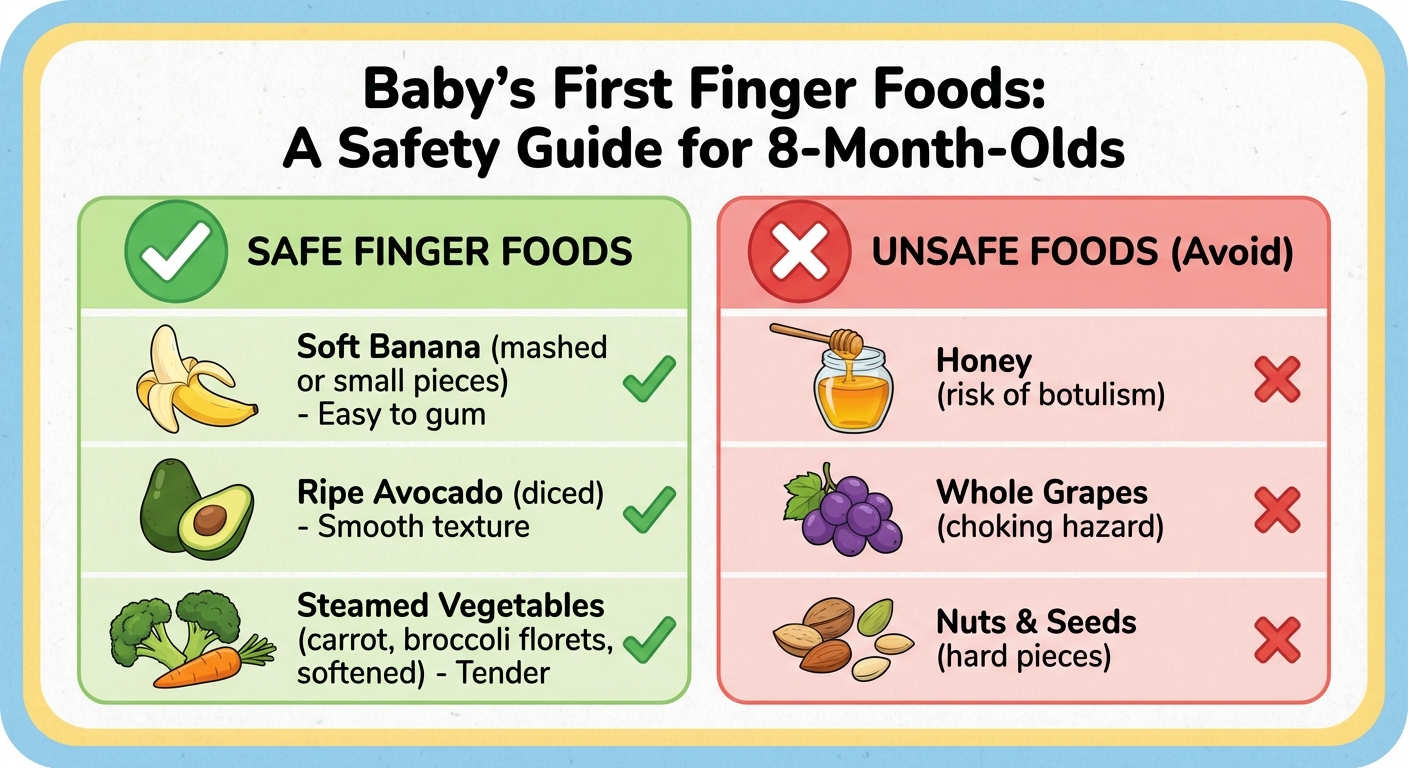
At 8 months, most (not all) babies show the following readiness signs for finger foods:
Palmar grasp: Can close fingers around an object held in the palm. This allows picking up pieces of food even before the pincer grasp (using thumb and forefinger) develops around 9-10 months.
Sitting balance: Can sit independently with only minimal support, freeing both hands for food exploration.
Munching movements: Vertical up-down jaw movement before adult rotary chewing develops. This is sufficient for soft foods.
Interest in food: Reaches for food others are eating, opens mouth when food approaches.
Not yet ready? All babies develop at different rates. If your 8-month-old is not yet showing interest in self-feeding, continue with pureed foods and try again in a few weeks. Developmental readiness is more important than chronological age.
The Squish Test: Texture Guideline
The most important safety guideline for finger foods: If you cannot squash the food between your thumb and forefinger using light pressure, it is not appropriate for an 8-month-old.
This means:
- Raw carrots: FAIL (too hard -- must be cooked until soft)
- Cooked carrot: PASS (squashes easily)
- Grapes whole: FAIL (too firm and round -- choking risk)
- Grapes quartered: Can pass -- but soft fruit in strips is safer
- Banana: PASS (naturally soft)
- Toast with spread: PASS (soft enough when moistened)
Size guideline: Pieces should be approximately finger-shaped (roughly 5-7cm long x 1-2cm wide) rather than small cubes. Babies at 8 months use a palmar grasp -- they grab and bring to mouth, not fine-pinch. A piece they can hold is safer than small pieces that can be swept into the mouth and swallowed whole.
Safe Finger Foods by Category
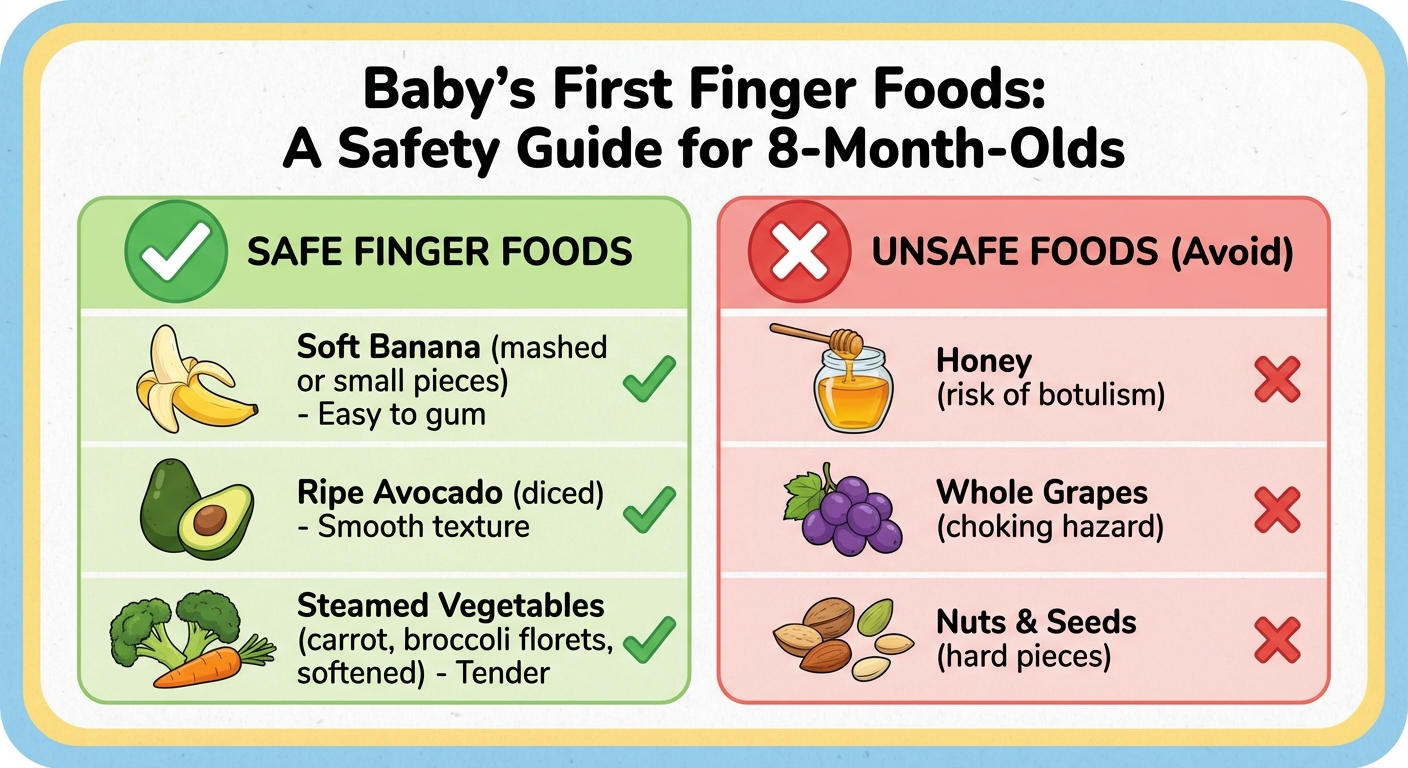
Vegetables
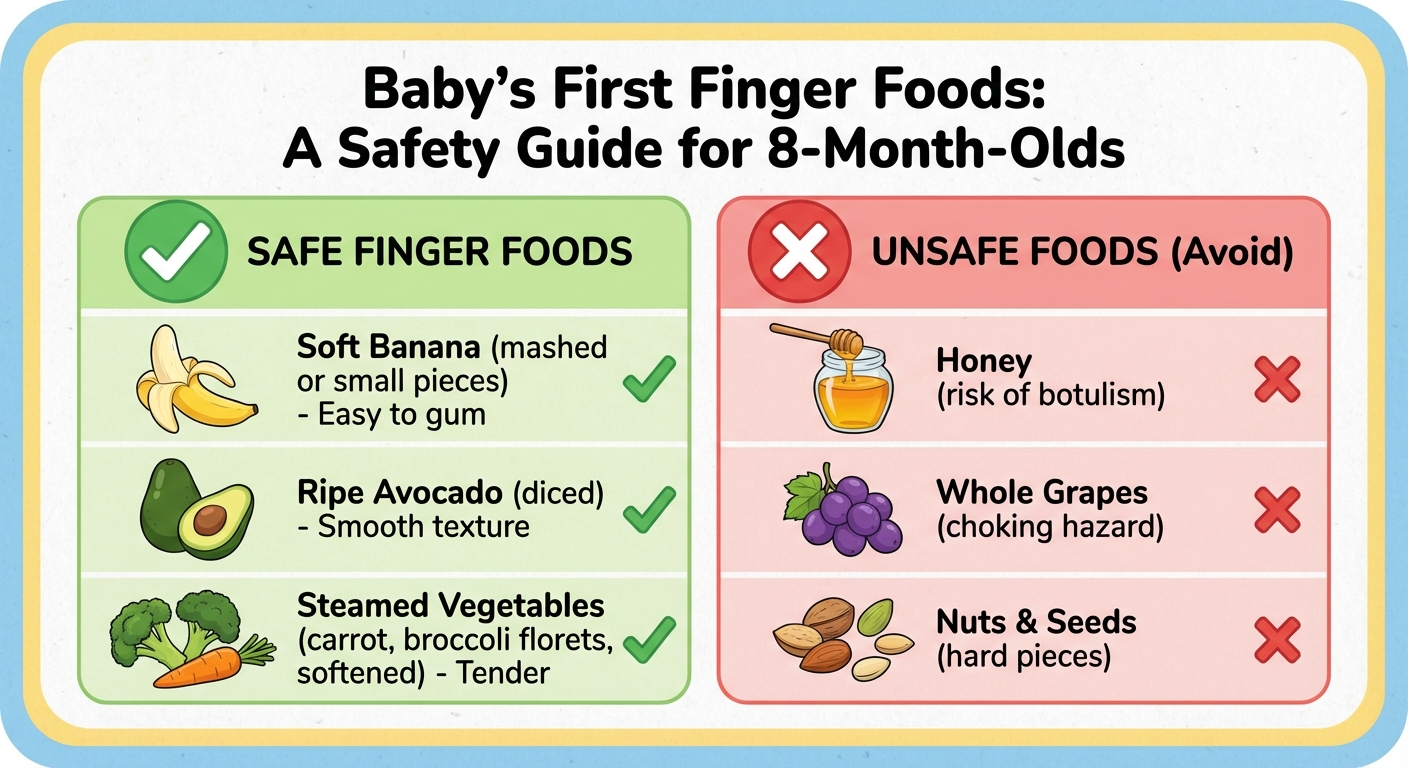
Carrot -- Steam or roast until fork-tender. Cut into thick batons (finger-shaped). Do not serve raw.
Sweet potato -- Roast or steam. Excellent texture and nutritional profile (vitamin A, potassium). Naturally soft when properly cooked.
Broccoli florets -- Steam until soft. The floret head acts as a natural handle for the baby to hold.
Butternut pumpkin/squash -- Roast until soft, cut into strips. Naturally sweet, high acceptance.
Avocado -- Ripe avocado needs no cooking. Cut into strips or wedges. Sprinkle with hemp seeds for texture grip.
Fruits
Banana -- Natural perfect texture. Cut into short batons. The peel can be partially left on as a handle for younger babies.
Mango -- Ripe mango flesh in strips. Soft, high vitamin C.
Peach/nectarine -- Ripe only. Peel if skin seems tough. Cut into strips.
Pear -- Ripe pear only. Remove skin. Hard, unripe pear is not appropriate.
Blueberries -- Can be offered whole but halve initially for safety. Soft when fresh-ripe.
Proteins
Scrambled egg -- Lightly scrambled (still slightly moist, not dry). Excellent iron and protein source.
Soft-cooked chicken -- Poached or slow-cooked until very tender. Shred into long strips along the muscle fibre. Avoid chunky pieces.
Flaked salmon -- Soft, naturally flaky. Excellent DHA for brain development. Check carefully for bones.
Soft tofu -- Silken tofu in cubes or strips. Easy texture for younger babies.
Grains and Bread
Toast fingers -- Slightly toasted whole grain bread cut into strips. Thin layer of nut butter (not thick -- aspiration risk), cream cheese, or avocado.
Soft-cooked pasta -- Penne or rigatoni cooked beyond al dente until soft. Wide ridged shapes are easiest to grasp.
Soft pancakes -- Made with egg and fruit for nutritional value. Cut into strips.
Dairy
Soft cheese strips -- Brie, fresh mozzarella, cream cheese on toast. Avoid hard cheese that doesn't squash.
Full-fat yogurt -- Age-appropriate plain full-fat yogurt. Can offer by preloaded spoon or thick enough to scoop.
For guidance on supporting breastfeeding nutrition during the solid food transition, see postpartum nutrition for breastfeeding for maternal dietary recommendations during this period.
Foods to Avoid at 8 Months
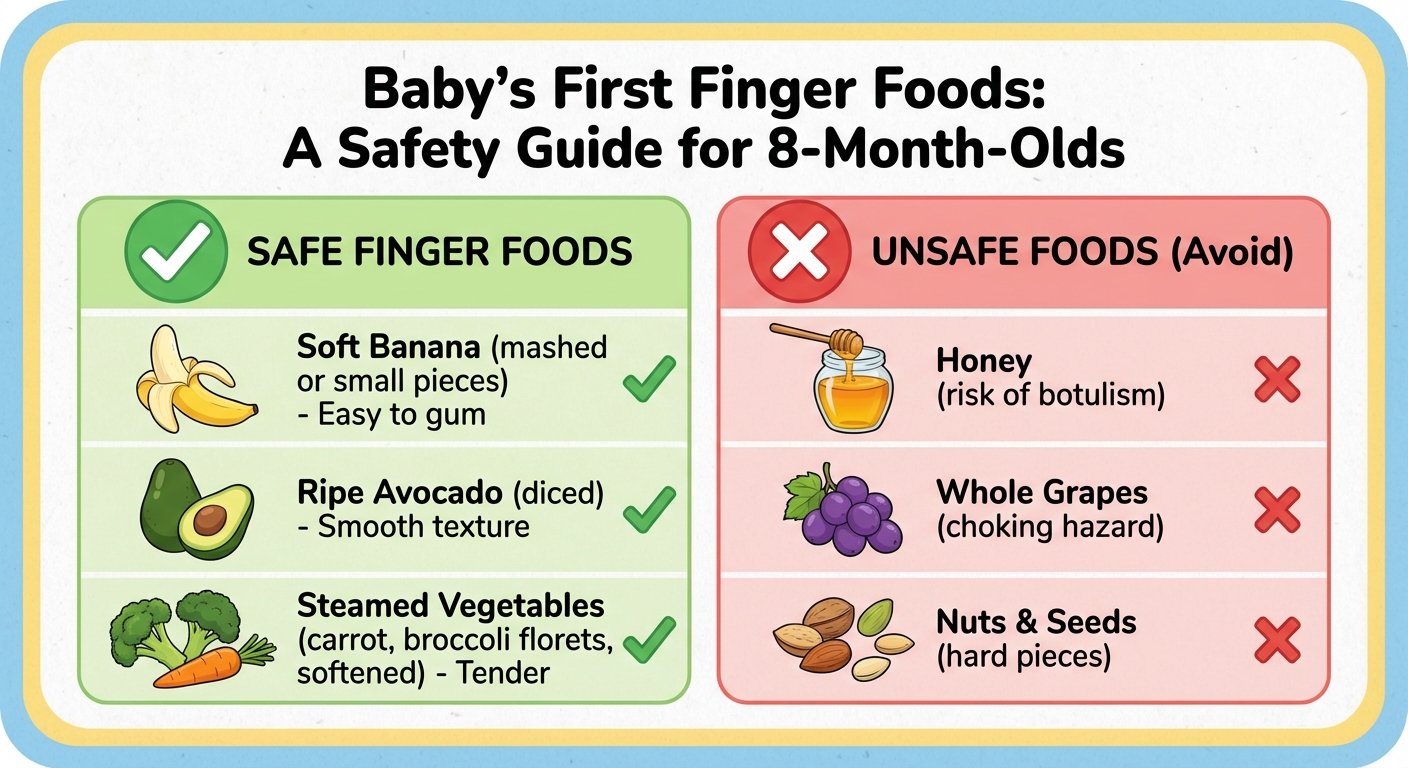
AVOID completely under 12 months:
- Honey (risk of infant botulism -- Clostridium botulinum spores)
- Cow's milk as main drink (breast milk or formula only as main drink until 12 months)
- Rice milk (nutritionally inadequate)
- High salt foods (kidneys cannot process -- no added salt, minimal processed foods)
- Added sugar
AVOID due to choking hazard (or prepare differently):
- Whole grapes, cherry tomatoes (must be quartered)
- Whole nuts (no whole nuts until 5+ years)
- Popcorn
- Raw hard vegetables
- Whole blueberries (halve for under 9 months)
- Stringy meat (avoid stringy fibres that can catch)
- Large pieces of any food
INTRODUCE carefully (allergens): Common allergens should be introduced one at a time, with several days between each new allergen, watching for allergic reactions. Current guidelines support early introduction (6-8 months) to reduce allergy risk. Talk to your paediatrician if there is a family history of food allergy.
Key allergens: peanut, tree nuts, egg, cow's milk (in food), wheat, fish, shellfish, soy.
Best Baby Feeding Products

Bumkins Silicone Suction Plate
Best for: Keeping plate on tray
Features: Suction base, divided sections
Check on Amazon
EZPZ Mini Mat + Plate
Best for: Baby-led weaning setup
Features: Integrated mat and plate, suction
Check on Amazon
IKEA Antilop High Chair
Best for: Easy clean, affordable
Features: Footrest, tray, easy wipe surfaces
Check on Amazon
NumNum Pre-Spoon GOOtensils
Best for: Early self-feeding with purees
Features: Pre-spoon shape, easy to load
Check on Amazon
Bibado Coverall Weaning Bib
Best for: Full coverage during finger food meals
Features: Long-sleeve waterproof design
Check on AmazonFrequently Asked Questions
What finger foods can an 8-month-old eat? Soft-cooked vegetables, ripe soft fruit, scrambled egg, soft-cooked chicken, soft-cooked pasta, toast strips, soft cheese, and yogurt. All must pass the squish test.
How do I know if a food is safe? Squish test: soft enough to squash between thumb and forefinger with light pressure. Serve in strips/batons not small choking-sized pieces.
Can 8-month-olds have eggs? Yes -- current guidelines recommend introducing egg by 6-8 months to reduce allergy risk. Scrambled or soft-boiled are good textures.
What should I not give my 8-month-old? Honey (botulism risk), whole grapes or cherry tomatoes, popcorn, whole nuts, high-salt foods, added sugar, raw hard vegetables.
Sources & Methodology
- National Health and Medical Research Council Australia. (2013). Infant Feeding Guidelines.
- American Academy of Pediatrics. (2022). Starting Solid Foods. AAP Clinical Report.
- Rapley G, Murkett T (2008). Baby-Led Weaning. Vermilion.
- ASCIA (Australasian Society of Clinical Immunology and Allergy). (2022). Infant Feeding and Allergy Prevention Guidelines.
- Fangupo LJ et al. (2016). Baby-Led Introduction to SolidS. Pediatrics, 138(4).
For more baby feeding guides, see our articles on baby-led weaning vs purees, best high chairs 2026, and baby food allergy introduction guide.
Dr. Sarah Mitchell is a Paediatric Nutrition Specialist with a focus on evidence-based approaches to infant feeding and early food introduction.
How to Prepare Finger Foods for 8-Month-Olds
Vegetables: Cooking Guidance
Carrots: Peel, cut into thick batons (5-7cm long x 1-1.5cm thick). Steam 10-12 minutes or roast 25 minutes at 180C until fork-tender. Test with the squish test before serving.
Sweet potato: Peel, cut into thick wedges or batons. Roast 25-30 minutes at 180C with a tiny amount of olive oil. No salt needed.
Broccoli: Cut into small florets with a long stem (the stem is the handle). Steam 8-10 minutes. The floret should squash under gentle pressure.
General principle: Cook all vegetables more than you think necessary. Under-cooked vegetables pass the squish test visually but may be fibrous and harder to chew safely.
Fruits: Preparation
Banana: Peel halfway down for a natural handle. Cut into 3-4 finger-length sections. Or peel completely and cut into strips.
Avocado: Peel and cut into long strips (roughly finger-length). Sprinkle with hemp seeds or chia seeds for extra nutrition and grip texture.
Mango: Peel and cut parallel to the flat seed in long strips.
General principle: Fruit should be genuinely ripe. Unripe fruit is harder and less nutritious. If you wouldn't enjoy eating it raw, it's not ready for a baby.
Proteins: Safe Preparation
Scrambled egg: Use butter (not just oil). Cook over low heat, stirring slowly. Remove from heat while still slightly moist -- not rubbery. Serve in a soft mound or strips.
Chicken: Poach chicken breast in water/stock for 20-25 minutes until very tender. Shred along the muscle fibre into long strips. Do not serve chunky cubes.
Salmon: Bake at 180C for 12-15 minutes. Flake into pieces, check meticulously for bones. Serve in a small pile -- the baby will pick up natural-sized pieces.
Managing Gagging vs Choking
New parents often confuse gagging (normal and protective) with choking (emergency). Understanding the difference is essential:
Gagging is a protective reflex where the tongue pushes food back before it reaches the throat. Signs: baby makes a retching movement, may cough, face may redden briefly. The object does not obstruct breathing. This is normal, expected, and part of safe learning. Do not rush to intervene.
Choking is a genuine airway obstruction. Signs: no sound, cannot cough, struggling to breathe, face turning blue. Requires immediate action (see first aid guidance).
Gagging frequency decreases significantly after 2-4 weeks of regular finger food experience. It is not a sign that finger foods are not appropriate -- it is the baby's airway protection system working correctly.
The key rule: stay calm during gagging and observe. Only intervene for true choking signs.
Building a Feeding Schedule at 8 Months
A typical 8-month feeding schedule:
Morning: Breast milk or formula (primary nutrition). Solid finger food meal 30-60 minutes later.
Mid-morning: Breast milk or formula feed.
Midday: Small finger food meal (2-4 tablespoons or finger food portion). Breast milk or formula after.
Afternoon: Breast milk or formula feed. Small solid snack optional.
Evening: Finger food dinner meal. Breast milk or formula bedtime feed.
At this age, breast milk or formula still provides the majority of nutritional needs. Solid food is primarily about skill development, food exposure, and gradual introduction to family foods -- not caloric replacement of milk.
Total solid food intake at 8 months is highly variable. A baby who eats 1 tablespoon per meal is completely normal. A baby who eats 4-6 tablespoons per meal is also normal. Do not compare to other babies -- follow your individual baby's hunger cues.