First Foods
The Best Baby Food Ideas for 6 Months Old (2026)
By Dr. Emma Clarke · Updated
The best baby food ideas for 6 months old babies include iron-fortified cereal, pureed sweet potato, mashed avocado, soft-cooked carrot sticks, banana, and pureed peas. Start with single-ingredient foods, introduce one new food every two to three days, and always prioritise iron-rich options alongside continued breast milk or formula feeds.
By Dr. Emma Clarke, Registered Dietitian | Last updated: March 12, 2026
⚠️ Medical Disclaimer: This article is for informational purposes only and does not constitute medical advice. Always consult your paediatrician or registered dietitian before introducing new foods to your baby.
Table of Contents
- When to Start Solids
- Best First Foods at 6 Months
- Baby-Led Weaning vs Purees
- Foods to Avoid at 6 Months
- Sample Weaning Schedule
- Tips for Success When Starting Solids
- FAQs
- Sources & Methodology
When to Start Solids
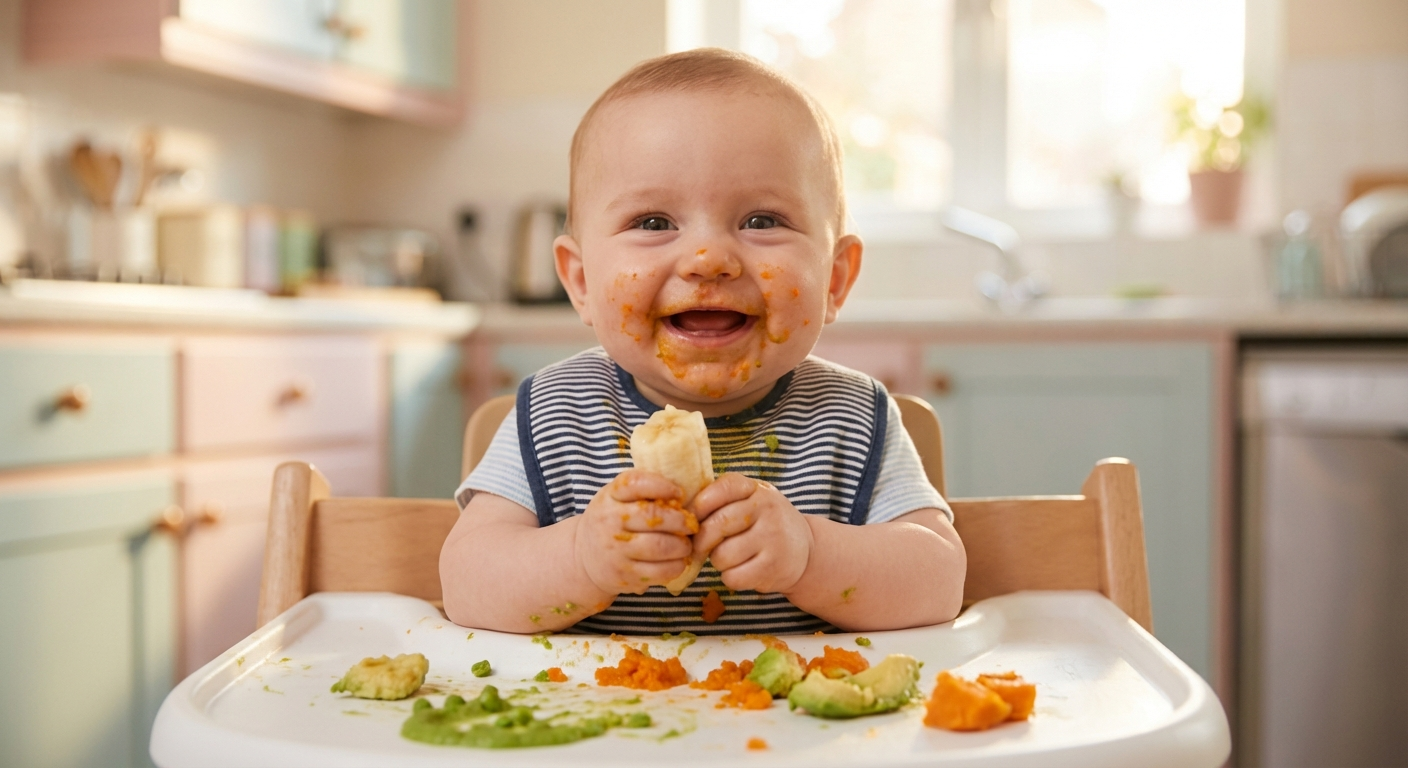
Around the 6-month mark, most babies are developmentally ready to begin exploring solid foods. Both the World Health Organisation (WHO) and the American Academy of Pediatrics (AAP) recommend exclusive breastfeeding (or formula feeding) for the first six months of life, with complementary foods introduced from around 6 months onward.
However, the calendar alone does not determine readiness. Before offering your baby their first taste of food, look for these three key signs of readiness:
- They can sit upright and hold their head steady. Your baby needs good head and neck control to swallow safely.
- They coordinate eyes, hands, and mouth. You will notice them watching you eat, reaching for food, and bringing objects to their mouth.
- They have lost the tongue-thrust reflex. When food is placed in their mouth, they can move it to the back and swallow rather than pushing it straight back out.
All three signs should be present before you begin. Some babies show these signs a little before 6 months, while others take a few weeks longer. If your baby was born prematurely, speak with your paediatrician about the best time to start solids based on their corrected age.
It is worth noting that waking more frequently at night or wanting extra milk feeds alone are not reliable indicators that your baby needs solid food. These are normal developmental behaviours that can happen for many reasons.
Why Iron Matters at 6 Months
By around 6 months, the iron stores that your baby was born with begin to deplete. Breast milk, while perfect in many ways, is relatively low in iron. This is why paediatric nutrition guidelines emphasise starting with iron-rich first foods. Formula-fed babies receive iron through their formula, but they also benefit from iron-rich solids at this stage.
Iron supports brain development, immune function, and healthy growth. Prioritising iron-rich foods from the very beginning of your baby's weaning journey is one of the most impactful nutritional decisions you can make.
Best First Foods at 6 Months
First Foods Comparison Table
| Food | Iron Content | Prep Method | Texture Type | Top Allergen (Y/N) | BLW-Friendly (Y/N) |
|---|---|---|---|---|---|
| Iron-fortified oat cereal | High | Mix with breast milk or formula | Smooth | N | N |
| Pureed sweet potato | Low | Steam and puree | Smooth | N | Y (as soft sticks) |
| Mashed avocado | Low | Mash with fork | Smooth/lumpy | N | Y |
| Smooth peanut butter (diluted) | Moderate | Thin with milk or mix into porridge | Smooth | Y | N |
| Well-cooked broccoli florets | Low | Steam until very soft | Soft solid | N | Y |
| Pureed lentils | High | Cook and puree | Smooth | N | N |
| Mashed banana | Low | Mash with fork | Smooth/lumpy | N | Y |
| Scrambled egg | Moderate | Scramble with no added salt | Soft solid | Y | Y |
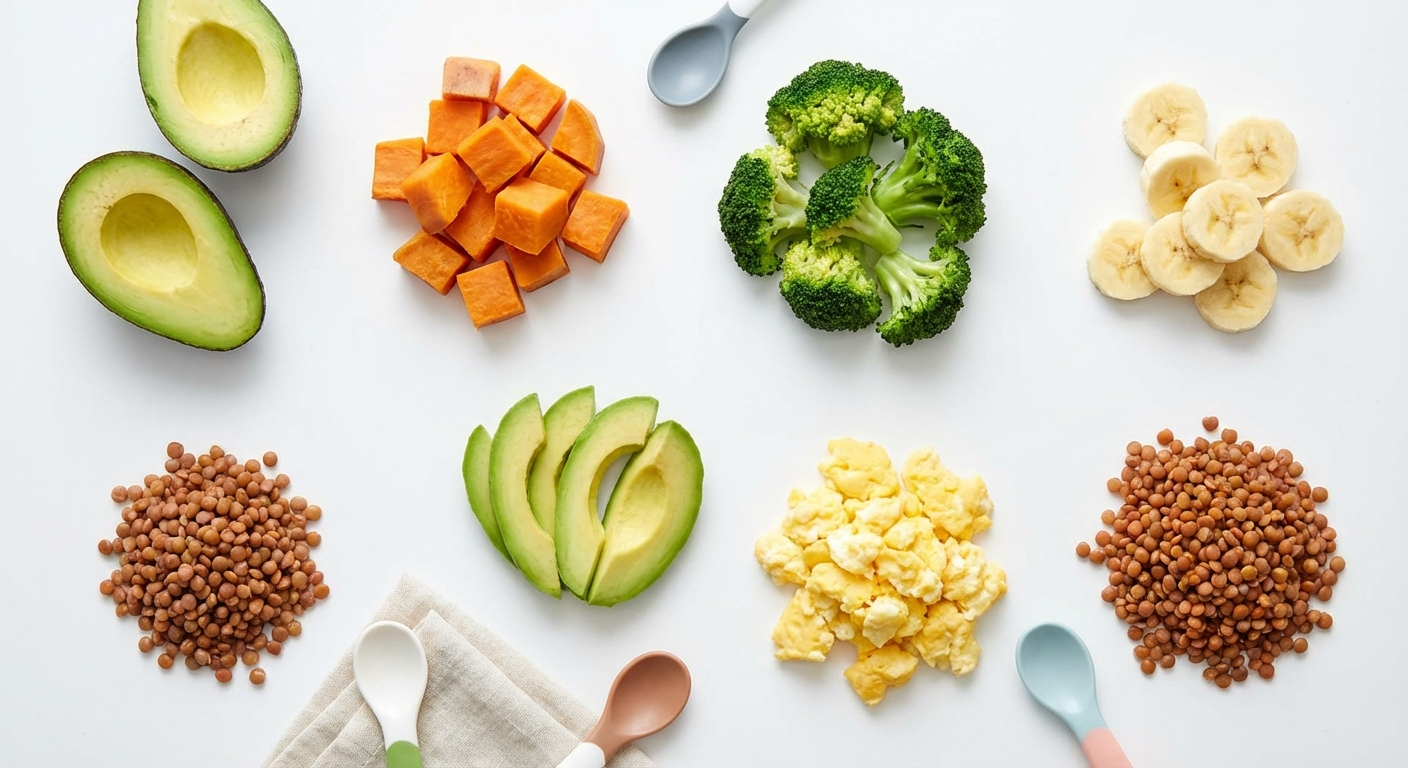
When choosing the best first foods for your baby, focus on nutrient density, simple flavours, and safe textures. Here are the top baby food ideas for 6 months old babies, grouped by category.
Iron-Rich Foods (Start Here)
- Iron-fortified baby cereal — mix with breast milk or formula for a familiar flavour and smooth texture
- Pureed red meat (beef or lamb) — one of the best sources of highly absorbable haem iron
- Pureed chicken or turkey — mild in flavour and easy to combine with vegetables
- Pureed lentils — an excellent plant-based iron source, and a great first pulse for babies
- Pureed beans (butter beans, black beans) — high in iron and fibre
Vegetables
- Sweet potato — naturally sweet, smooth when pureed, and packed with beta-carotene
- Butternut squash — another naturally sweet option that most babies enjoy
- Peas — blend well into a smooth puree and provide iron and protein
- Carrot — a classic first food; cook until very soft and puree or serve as soft sticks
- Broccoli — steamed florets make excellent finger food for baby-led weaning
- Courgette (zucchini) — mild flavour and soft texture when cooked
Fruits
- Banana — no cooking required; mash with a fork for an instant first food
- Avocado — rich in healthy fats and incredibly smooth when mashed
- Pear — gentle on the stomach, naturally sweet, and easy to puree
- Apple — cook and puree; pairs beautifully with many vegetables
- Mango — ripe mango mashes easily and is rich in vitamins A and C
Grains and Starches
- Baby oat porridge — mix with breast milk or formula for a creamy first cereal
- Well-cooked soft pasta — small shapes work well as finger food from 6 months
- Rice — cooked until very soft; combine with pureed vegetables
Early Allergen Introduction
Current evidence, supported by both the AAP and the British Society for Allergy and Clinical Immunology (BSACI), suggests that introducing common allergens early — from around 6 months — may help reduce the risk of developing food allergies. Key allergens to introduce include:
- Peanut — offer as smooth peanut butter mixed into porridge or a puree (never whole or chopped nuts)
- Cooked egg — start with well-cooked egg, such as hard-boiled and mashed
- Cow's milk dairy — as yoghurt or cheese in cooking (not as a main drink before 12 months)
- Wheat — through baby cereal or soft bread strips
- Fish — well-cooked, flaked, and deboned white fish is an excellent first protein
Introduce one new allergen at a time and wait two to three days before offering the next so you can observe any potential reactions.
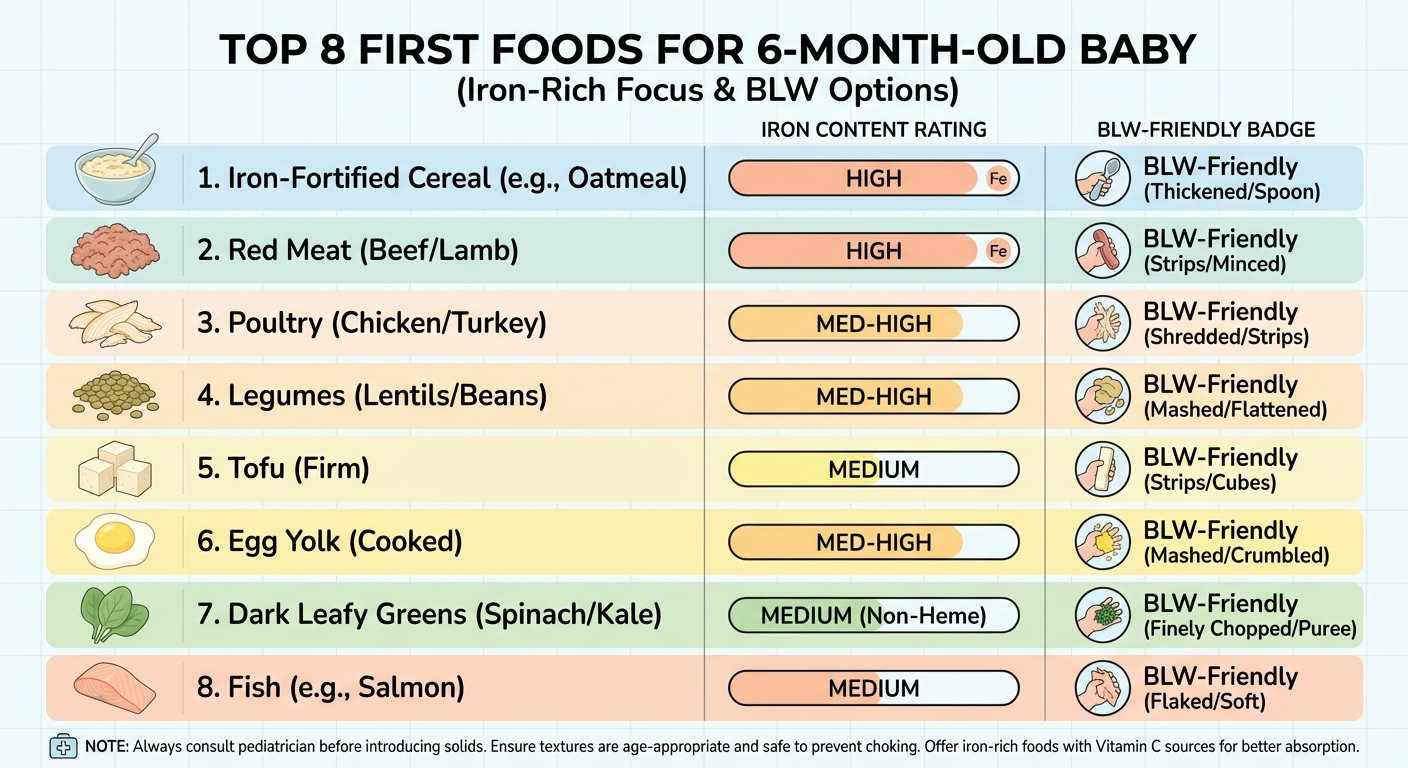
For a deeper dive into the best foods for this stage, read our full guide on best baby weaning foods for 6 months.
Baby-Led Weaning vs Purees
One of the biggest decisions parents face when starting solids at 6 months is whether to use traditional puree-based weaning, baby-led weaning (BLW), or a combination of both. There is no single correct answer — the right approach depends on your baby's development and your family's preferences.
Traditional Puree-Based Weaning
With this approach, you spoon-feed your baby smooth purees and gradually increase the texture over weeks and months. It gives you more control over how much your baby eats and can feel reassuring for first-time parents.
Pros:
- Easier to track how much food your baby is consuming
- You can introduce a wide variety of flavours quickly
- Less mess (relatively speaking)
- Good for babies who are slow to develop pincer grip
Cons:
- Baby is passive — less opportunity to develop self-feeding skills early
- Can delay acceptance of lumpy textures if progression is too slow
- Requires more preparation time (cooking, blending, portioning)
How to progress textures:
- Week 1–2: Smooth, thin purees
- Week 3–4: Slightly thicker, lumpier purees
- Month 2–3: Mashed foods with soft lumps
- Month 3+: Finely chopped and soft finger foods
Baby-Led Weaning (BLW)
BLW skips purees entirely. Instead, you offer your baby soft, appropriately sized pieces of food and let them feed themselves from the start. The food should be cut into finger-length strips or pieces that your baby can grasp in their fist.
Pros:
- Encourages self-regulation of appetite
- Promotes development of motor skills and hand-eye coordination
- Baby eats the same meals as the family (with modifications for safety)
- May encourage more adventurous eating long-term
Cons:
- More mess — food goes everywhere during the learning phase
- Harder to ensure adequate iron intake in the early weeks
- Can be anxiety-inducing for parents due to gagging episodes
- Not suitable for babies who cannot yet sit with minimal support
Safety considerations:
- Your baby must be able to sit upright with minimal support
- Always supervise mealtimes
- Learn the difference between gagging (normal and protective) and choking (an emergency)
- Avoid hard, round, or coin-shaped foods
The Combination Approach
Many parents find that a mixed approach works best. You might offer purees on a spoon while also placing soft finger foods on the high-chair tray for your baby to explore independently. This gives your baby the benefits of both methods and allows flexibility.
Most paediatric dietitians recommend starting with smooth purees at 6 months and introducing soft finger foods from 7 months — combining the best of both approaches.
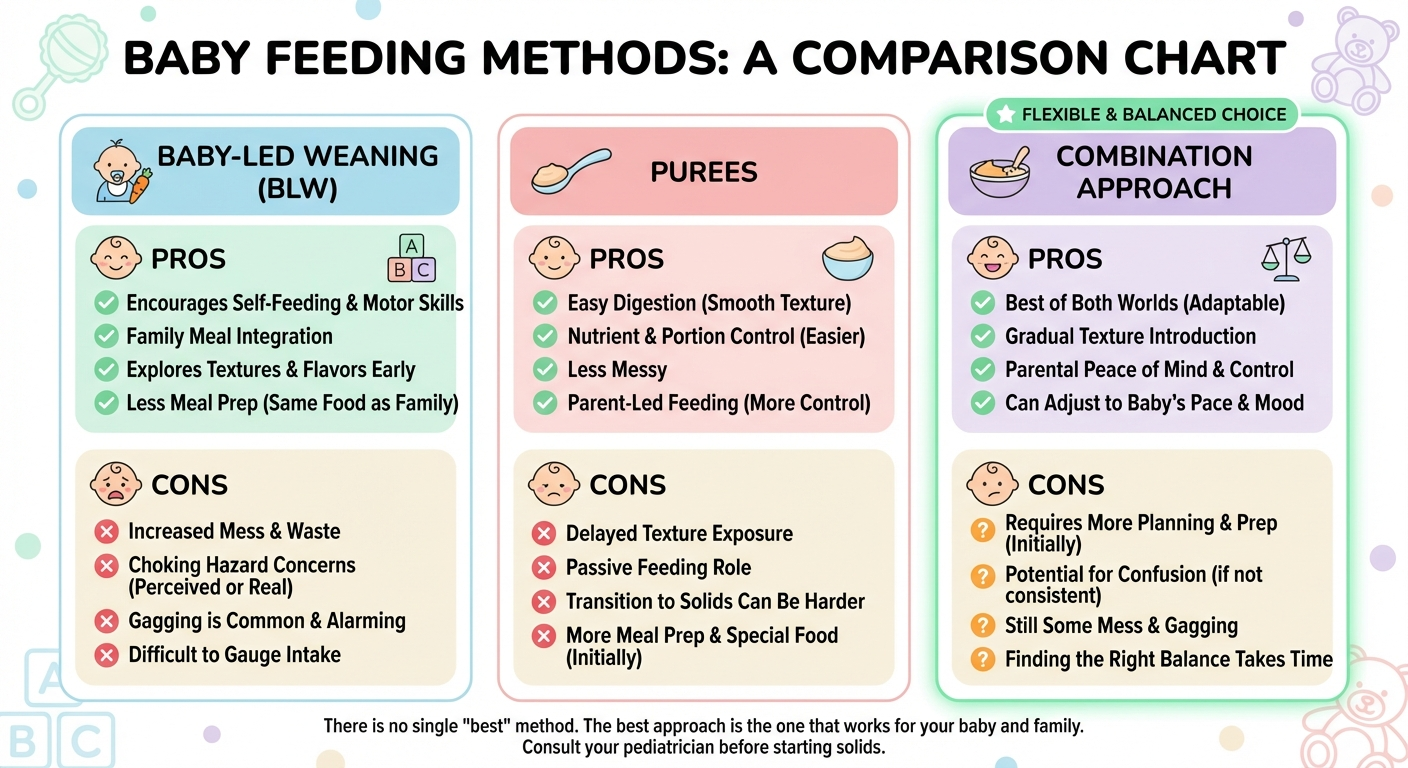
For a detailed comparison with pros, cons, and practical advice, see our dedicated article on baby-led weaning vs purees.
Foods to Avoid at 6 Months
While most whole foods are suitable for babies from 6 months, there are some important exceptions to keep your little one safe:
Never Give to Babies Under 12 Months
- Honey — carries a risk of infant botulism, a rare but serious illness caused by Clostridium botulinum spores
- Whole nuts, seeds, or large chunks of hard food — significant choking hazard
- Cow's milk as a main drink — it does not provide the right balance of nutrients; use breast milk or formula as the main milk until 12 months
- Added salt — babies' kidneys cannot process excess sodium; avoid adding salt to any food
- Added sugar — unnecessary and can encourage a preference for sweet foods
- Rice milk — may contain traces of arsenic
- Raw or undercooked shellfish — risk of food poisoning
- Shark, swordfish, or marlin — high mercury levels
Choking Hazards to Modify
Some foods are safe once you prepare them correctly:
| Food | Risk | Safe Preparation |
|---|---|---|
| Grapes | Round shape, firm skin | Cut lengthways into quarters |
| Cherry tomatoes | Round shape | Cut into quarters |
| Raw apple | Hard texture | Cook until soft or grate finely |
| Sausages | Cylindrical shape | Remove skin, slice lengthways |
| Popcorn | Hard, small, irregular shape | Avoid entirely until age 4+ |
| Whole blueberries | Round shape | Squash or halve |
| Nut butters (thick) | Sticky, can block airway | Thin with milk or mix into porridge |
Sample Weaning Schedule
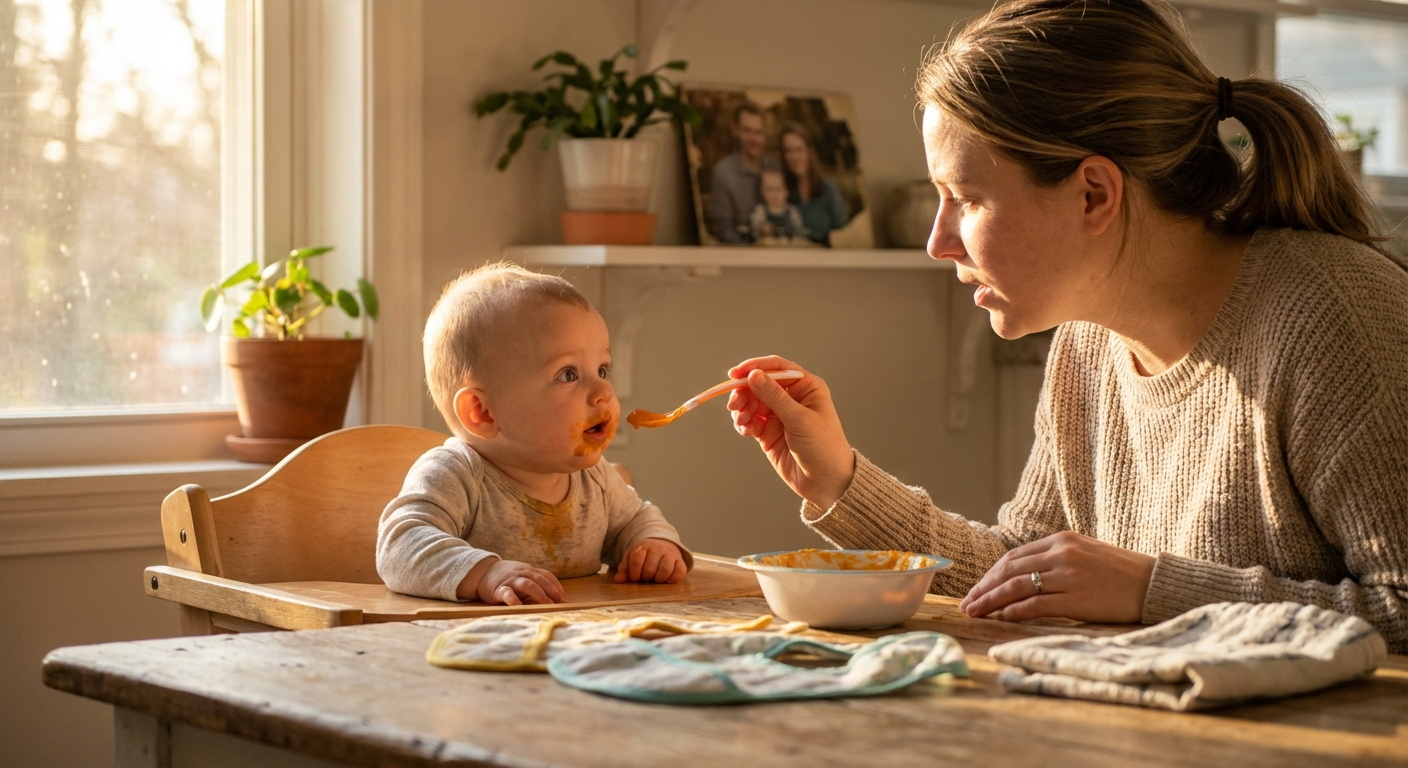
Starting solids does not mean replacing milk feeds. At 6 months, breast milk or formula remains your baby's primary source of nutrition. Solid food is complementary — it fills nutritional gaps (especially iron) and helps your baby learn to eat.
Here is a sample weaning schedule for the first four weeks of starting solids at 6 months. Adjust timing to suit your baby's routine.
Week 1: Getting Started
| Time | Feed |
|---|---|
| Early morning | Breast milk / formula |
| Mid-morning | 1–2 teaspoons of single-ingredient puree (e.g., sweet potato or baby rice), followed by milk feed |
| Lunchtime | Breast milk / formula |
| Afternoon | Breast milk / formula |
| Evening | Breast milk / formula |
| Bedtime | Breast milk / formula |
Goal: One solid "tasting session" per day. Focus on exposure, not volume.
Week 2: Building Confidence
| Time | Feed |
|---|---|
| Early morning | Breast milk / formula |
| Mid-morning | 2–4 teaspoons of puree (try a new vegetable such as carrot or peas), followed by milk feed |
| Lunchtime | Breast milk / formula |
| Mid-afternoon | Optional: 1–2 teaspoons of fruit puree (banana or pear) |
| Evening | Breast milk / formula |
| Bedtime | Breast milk / formula |
Goal: One to two solid sessions per day. Continue introducing new single-ingredient foods every two to three days.
Week 3–4: Expanding the Menu
| Time | Feed |
|---|---|
| Early morning | Breast milk / formula |
| Breakfast | Baby porridge with mashed fruit, followed by milk feed |
| Lunchtime | Vegetable puree with a protein (pureed chicken or lentils), followed by milk feed |
| Afternoon | Breast milk / formula |
| Evening | Breast milk / formula |
| Bedtime | Breast milk / formula |
Goal: Two solid meals per day. Start combining flavours and introduce iron-rich proteins.
By the End of Month 1
Your baby should be comfortable eating two small meals of solids per day alongside their regular milk feeds. There is no rush to reach three meals — most babies progress to three solid meals per day between 8 and 9 months.
Remember, the amount your baby eats will vary day to day. Some sessions they may eat several spoonfuls, while other times they may only taste and play. Both are completely normal. Trust your baby's appetite and never force food.
Tips for Success When Starting Solids
Drawing on my 12 years working with families through the weaning process, here are practical tips that genuinely make a difference:
1. Start with Vegetables Before Fruits
Babies are born with a natural preference for sweet flavours (breast milk is sweet). By offering vegetables first — particularly bitter and savoury ones like broccoli, courgette, and spinach — you give your baby the chance to accept these flavours before they become accustomed to sweeter options. Research published in the American Journal of Clinical Nutrition supports repeated early exposure to vegetables as a strategy for improving long-term vegetable acceptance.
2. Offer the Same Food Multiple Times
It can take 10 to 15 exposures before a baby accepts a new flavour. If your baby turns away from a particular food, do not assume they dislike it permanently. Set it aside and try again in a few days. Persistence without pressure is key.
3. Eat Together as a Family
Babies learn by watching. Sitting down to eat the same (or similar) food alongside your baby normalises the experience and encourages them to try what they see you eating.
4. Keep Mealtimes Calm and Positive
Avoid showing frustration if your baby refuses food or makes a mess. Keep sessions to 15–20 minutes. If your baby loses interest, end the meal calmly. A positive mealtime environment lays the groundwork for a healthy relationship with food.
5. Invest in the Right Equipment
You do not need a lot, but a few essentials help:
- A sturdy high chair that allows your baby to sit upright with feet supported
- Soft-tipped weaning spoons
- A suction bowl or plate to reduce spills
- A full-coverage bib (long-sleeved bibs are a lifesaver)
- A splash mat under the high chair
If you are making your own baby food at home, a reliable baby food maker or blender saves significant time. We have reviewed the top options in our guide to best baby food makers 2026.
6. Learn the Difference Between Gagging and Choking
Gagging is a normal, protective reflex. Your baby may cough, retch, or make retching faces as they learn to manage food in their mouth. Gagging is noisy and your baby will usually resolve it themselves.
Choking, on the other hand, is silent. If your baby is unable to cry, cough, or breathe, this is a choking emergency. Every parent and caregiver should complete a paediatric first-aid course that covers infant choking response before starting solids.
7. Prepare Food in Batches
Batch cooking and freezing purees in ice-cube trays is one of the most practical strategies for busy parents. Cook a selection of vegetables and proteins, blend them, and freeze in individual portions. You can then defrost and combine different cubes for varied meals throughout the week.
8. Introduce Water in an Open Cup
From 6 months, offer small sips of water with meals in an open cup or free-flow sippy cup. This helps your baby practise their drinking skills and supports hydration as they eat more solid food. Tap water is fine — no need to boil it after 6 months if your water supply is safe.
FAQs
What are the best first foods for a 6-month-old baby?
The best first foods for a 6-month-old include iron-rich options like iron-fortified baby cereal, pureed sweet potato, mashed avocado, pureed peas, and well-cooked soft fruits such as banana and pear. Iron-rich foods are especially important because your baby's natural iron stores begin to deplete around this age. Start with single-ingredient foods and wait two to three days before introducing the next one so you can watch for allergic reactions. Gradually increase the variety to include proteins (pureed chicken, lentils, beans), grains, and dairy.
How much food should a 6-month-old eat per day?
At 6 months, babies typically eat one to two tablespoons of solid food once or twice a day alongside their regular breast milk or formula feeds. Milk remains the primary source of nutrition throughout the first year, and solids are complementary. There is no specific calorie target for solids at this stage — the goal is exposure to flavours and textures. Gradually increase portions as your baby shows interest, and let them guide how much they eat. Some days they will eat more, other days less, and that is perfectly normal.
Can I do baby-led weaning at 6 months instead of purees?
Yes, baby-led weaning (BLW) can be started at 6 months provided your baby can sit upright with minimal support, has lost the tongue-thrust reflex, and shows active interest in food. With BLW, you offer soft, finger-sized pieces of food and allow your baby to self-feed. Always supervise mealtimes closely. Many parents also use a combination approach — offering spoon-fed purees alongside finger foods — which gives babies the benefits of both methods. The most important factor is that whatever approach you choose, the food is prepared safely and your baby is developmentally ready.
What foods should I avoid giving a 6-month-old?
Avoid honey until your baby turns 1 due to the risk of infant botulism. Never offer whole nuts, popcorn, or large chunks of hard raw fruit or vegetables as these are choking hazards. Do not add salt or sugar to your baby's food. Cow's milk should not be used as a main drink before 12 months (though it is fine in cooking or as yoghurt). Avoid fish with high mercury levels (shark, swordfish, marlin), raw or undercooked shellfish, and rice milk. When in doubt, consult your health visitor or paediatrician.
How do I know my baby is ready to start solids at 6 months?
Look for three key developmental signs: they can sit upright and hold their head steady, they can coordinate their eyes, hands, and mouth to look at food, pick it up, and bring it to their mouth, and they can swallow food rather than pushing it back out with their tongue. All three signs should be present before you start. Age alone is not a reliable indicator — some babies are ready just before 6 months, while others need a little more time. Waking at night or seeming hungrier than usual are not signs of readiness for solids on their own.
Should I introduce allergens early at 6 months?
Current guidance from the AAP, NHS, and BSACI recommends introducing common allergens — including peanut (as smooth peanut butter), well-cooked egg, dairy, wheat, soy, fish, and sesame — from around 6 months of age. Research, particularly the landmark LEAP study, has shown that early introduction can significantly reduce the risk of developing food allergies. Introduce one new allergen at a time, wait two to three days between new allergens, and offer them regularly (two to three times per week) once tolerated. If your baby has severe eczema or a known food allergy, consult your paediatrician or allergist before introducing allergens.
Do I need to buy a baby food maker or can I prepare food myself?
You absolutely do not need a dedicated baby food maker. A standard kitchen blender, food processor, or even a fork and potato masher will do the job. However, baby food makers offer convenience by steaming and blending in a single unit, which can save washing up and preparation time. They are particularly helpful if you plan to batch-prepare purees. Homemade baby food is generally more cost-effective than shop-bought jars and allows you to control exactly what goes into your baby's meals.
Sources & Methodology
This article is based on the latest evidence-based guidelines from leading paediatric health organisations. All recommendations reflect current best practice as of March 2026.
Primary sources:
- World Health Organisation (WHO). Complementary Feeding: Report of the Global Consultation. WHO recommends exclusive breastfeeding for the first 6 months, with complementary foods introduced thereafter. who.int
- American Academy of Pediatrics (AAP). Starting Solid Foods. AAP guidelines on introducing solids, iron-rich foods, and allergen introduction. aap.org
- NHS (UK National Health Service). Your Baby's First Solid Foods. NHS guidance on weaning signs of readiness, first foods, and foods to avoid. nhs.uk
- Du Toit, G. et al. (2015). Randomized Trial of Peanut Consumption in Infants at Risk for Peanut Allergy (LEAP Study). New England Journal of Medicine, 372(9), 803–813. Landmark study supporting early allergen introduction.
- British Society for Allergy and Clinical Immunology (BSACI). Early Feeding Guidance. Recommendations on the early introduction of allergenic foods in infants.
- Coulthard, H., Harris, G., & Emmett, P. (2009). Delayed introduction of lumpy foods to children during the complementary feeding period affects child's food acceptance and feeding at 7 years of age. Maternal & Child Nutrition, 5(1), 75–85.
- Scientific Advisory Committee on Nutrition (SACN). Feeding in the First Year of Life. SACN report underpinning UK government weaning recommendations.
Methodology: All food suggestions in this article have been reviewed against current paediatric nutrition guidelines. I have cross-referenced multiple national and international sources to ensure accuracy. Where research is evolving (such as allergen introduction timelines), I have noted the most current consensus. This article is for educational purposes and does not replace personalised medical advice from your child's healthcare provider.