Weaning Challenges
Baby Refusing Solids? 9 Expert-Backed Solutions (2026)
By Dr. Emma Clarke · Updated
If your baby is refusing solids, take a breath — this is one of the most common weaning challenges, and it is almost always a normal phase. The key is to stay calm, remove pressure from mealtimes, and use gradual, evidence-based strategies to build your baby's confidence with food. Below you will find nine expert-backed solutions that work.
By Dr. Emma Clarke, Registered Dietitian | Last updated: March 12, 2026
⚠️ Medical Disclaimer: This article is for informational purposes only and does not constitute medical advice. Always consult your paediatrician or registered dietitian before introducing new foods to your baby.
Table of Contents
- Why Do Babies Refuse Solids?
- 9 Expert-Backed Solutions for a Baby Who Won't Eat Solids
- When to See a Doctor
- Frequently Asked Questions
- Sources and Methodology
Why Do Babies Refuse Solids?
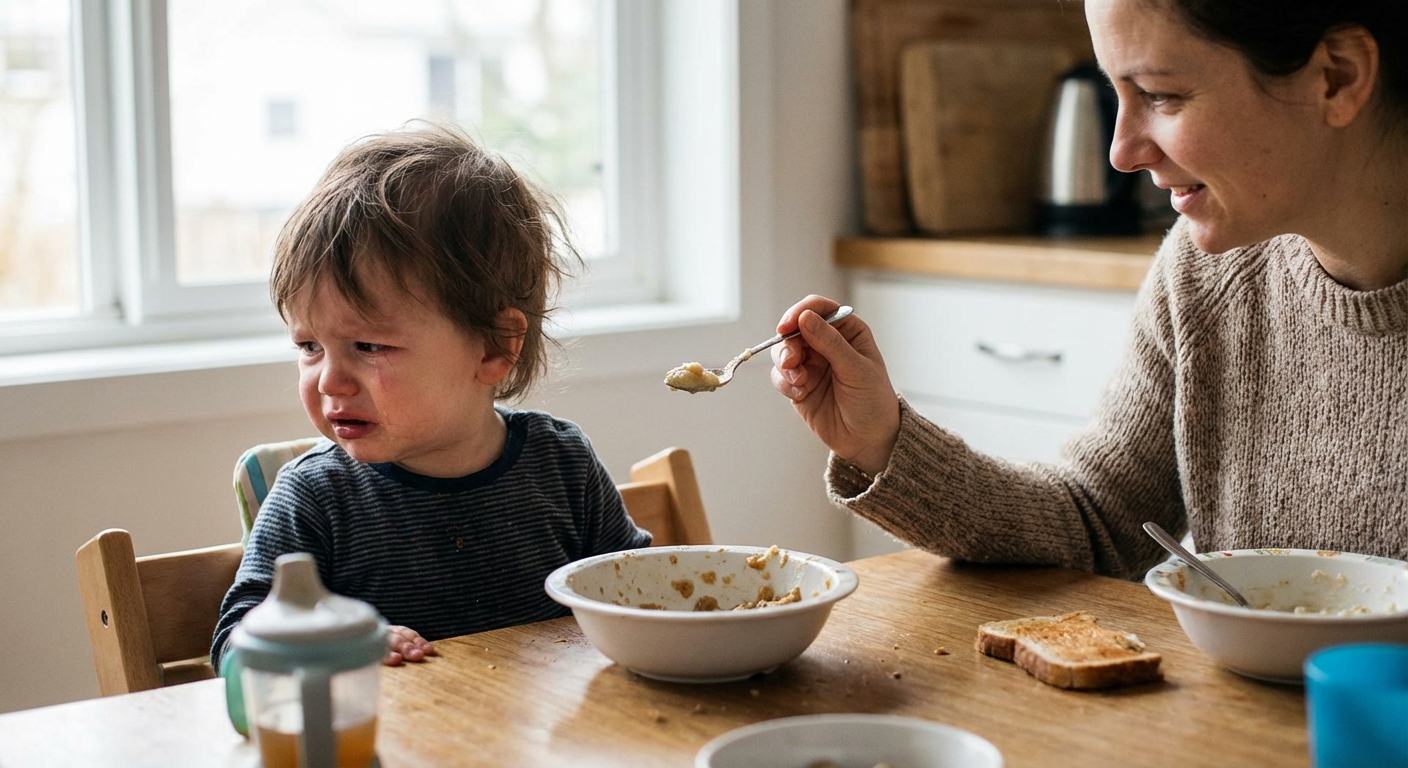
Before jumping into solutions, it helps to understand what is going on. A baby refusing solids is rarely about being "fussy" — there is usually a developmental, sensory, or environmental reason behind the behaviour.
Here are the most common causes I see in my clinic:
They are not developmentally ready
The World Health Organization recommends introducing solids at around 6 months, but "around" is doing a lot of heavy lifting in that sentence. Some babies are ready at 5.5 months; others are not quite there until closer to 7 months. Readiness signs include sitting upright with minimal support, showing interest in food others are eating, reaching for food, and losing the tongue-thrust reflex that pushes food back out of their mouth.
If your baby is pushing food out with their tongue every time, they may simply need a few more weeks.
They are overwhelmed by texture
Moving from a liquid-only diet to solid food is a massive sensory leap. The feeling of a lumpy puree or a piece of steamed carrot on the tongue can be genuinely startling for a baby who has only ever known milk. Some babies need a slower, more gradual texture progression.
They are too hungry or too full
This is one of the most overlooked causes of weaning refusal. A baby who has just had a full milk feed has zero motivation to explore solids. Conversely, a baby who is starving and overtired will scream for the breast or bottle because that is the fastest, most comforting source of food they know. Timing matters enormously.
They are teething or unwell
Sore gums, a blocked nose, an ear infection, reflux — any source of discomfort can temporarily knock a baby off solids. This is not a setback. It is a pause.
They are picking up on mealtime stress
Babies are remarkably sensitive to the emotional tone at the table. If you are anxious, hovering with every spoonful, or visibly frustrated when food ends up on the floor, your baby will associate mealtimes with tension. Pressure — even well-intentioned pressure — is the enemy of progress.
 Keeping mealtimes relaxed and pressure-free encourages babies to explore food at their own pace.
9 Expert-Backed Solutions for a Baby Who Won't Eat Solids
These strategies are grounded in current guidelines from the American Academy of Pediatrics (AAP), the World Health Organization (WHO), and the European Society for Paediatric Gastroenterology, Hepatology and Nutrition (ESPGHAN). I have used every one of them with families in my practice.
1. Check the Readiness Signs — Not Just the Calendar
The single most effective thing you can do is step back and honestly assess whether your baby is showing readiness cues. A baby who is not developmentally ready to eat will refuse food no matter how perfectly you prepare it.
What to look for:
- Can sit upright in a highchair with good head and neck control
- Shows curiosity about food — watches you eat, reaches toward your plate
- Opens their mouth when food is offered nearby
- Can move food from the front of the tongue to the back to swallow (tongue-thrust reflex has faded)
If your baby is not ticking these boxes, wait one to two weeks and try again. This is not failure — it is responsive parenting.
2. Adjust Your Milk-to-Solids Timing
Getting the timing right between milk feeds and solid food can make or break a weaning session. I recommend what I call the "sweet spot window."
The sweet spot window:
- Offer solids 30 to 60 minutes after a milk feed (breast or formula)
- Your baby should be content but not stuffed — alert and curious, not desperate for calories
- Aim for one to two solid food sessions per day to start, building gradually
Many parents make the mistake of replacing a milk feed with solids too early. Until 12 months, breast milk or formula remains the primary source of nutrition. Solids are complementary — think of them as practice, not a main course.
3. Start With Single-Ingredient, Mild Flavours
If your baby is not interested in food, simplify. Start with single-ingredient foods that have a naturally mild, slightly sweet flavour profile. These are easier for developing palates to accept.
Strong starting foods:
- Sweet potato puree
- Ripe avocado (mashed or as soft strips for baby-led weaning vs purees)
- Banana (mashed or served as a whole peeled piece for self-feeding)
- Iron-fortified baby cereal mixed with breast milk or formula
- Steamed and pureed pear
For more age-appropriate food inspiration, see our guide to the best weaning foods for 6 months.
Once your baby is comfortable with single ingredients, you can begin combining flavours and exploring a wider range of textures and foods.
4. Offer Food Without Any Pressure
This is the strategy I spend the most time coaching parents on because it is both the most important and the hardest to implement when you are worried about your baby's nutrition.
What "no pressure" looks like in practice:
- Place food on the highchair tray or offer a loaded spoon, then sit back
- Do not hover or stare intensely at every mouthful
- If your baby turns away, closes their mouth, or pushes the spoon away — stop immediately
- Never force a spoon into a closed mouth
- Keep sessions short: 10 to 15 minutes maximum
- Stay neutral — no animated cheering for every bite and no visible disappointment when food is rejected
Research published in the journal Appetite consistently shows that pressure to eat is associated with lower food intake and increased fussiness in young children. The goal is to make mealtimes feel safe and low-stakes.
5. Eat Together as a Family
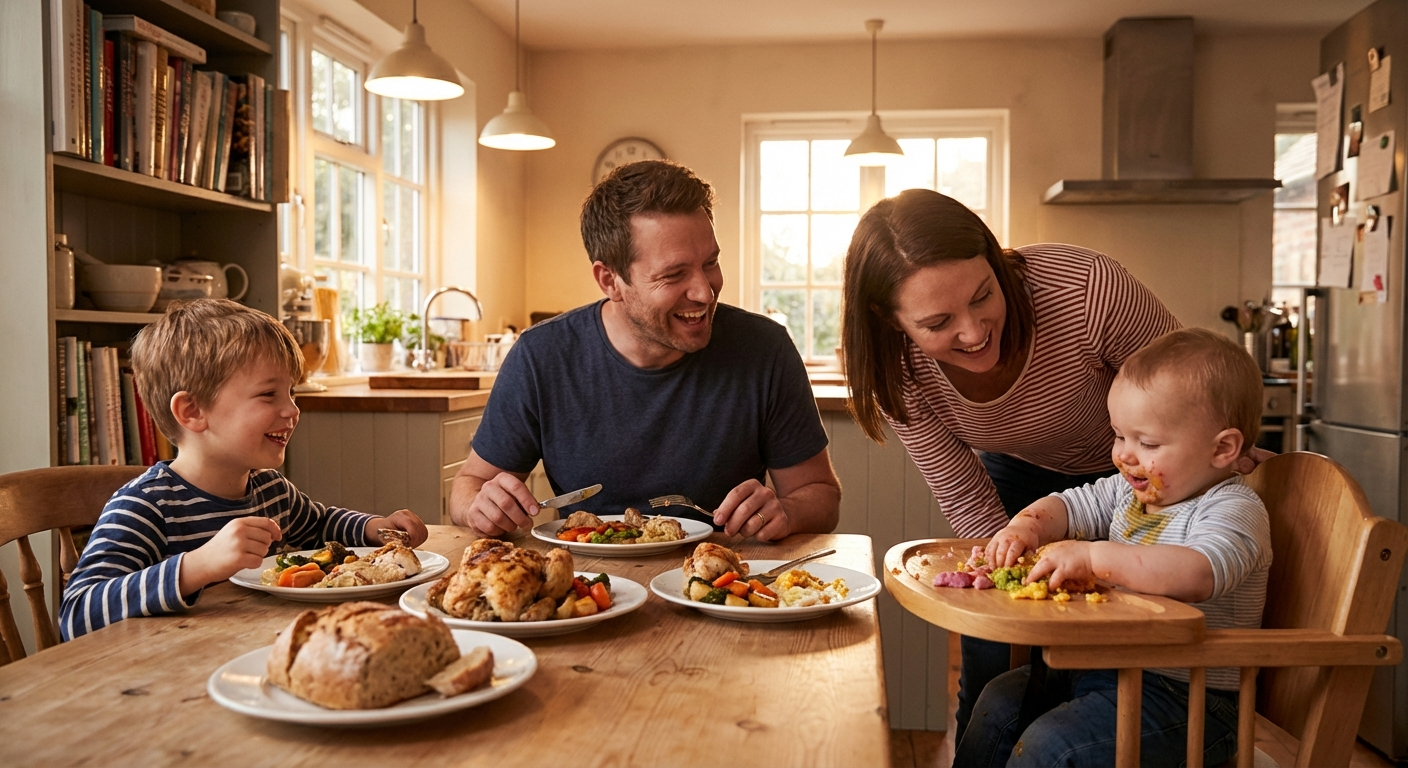
Babies learn by watching. Sitting your baby at the table while the family eats is one of the most powerful (and most underused) strategies for encouraging food acceptance.
Why it works:
- Babies are natural mimics — seeing parents chew and swallow normalises eating
- Shared mealtimes reduce the performance-like pressure of sitting alone in a highchair while a parent spoon-feeds
- Exposure to a variety of foods on other people's plates builds curiosity over time
Even if your baby does not eat a single bite, sitting at the table and observing is progress. It counts.
6. Explore Different Textures and Temperatures
If purees are not working, try finger foods. If warm food is being rejected, try room temperature or slightly cool options. Babies can have strong texture and temperature preferences that we only discover through experimentation.
Texture ideas to try:
- Smooth purees (stage 1)
- Thicker, mashed textures with soft lumps
- Soft finger foods: steamed broccoli florets, strips of ripe mango, cooked pasta spirals
- Crunchy-melt textures: puffed rice snacks, thin rice cakes
Temperature tips:
- Some babies prefer food at room temperature rather than warm
- During teething, chilled purees or cold fruit in a mesh feeder can feel soothing on sore gums
- Warm porridge or cereal can be comforting for babies who prefer warm feeds
There is no single right texture or temperature. Your job is to be a curious experimenter, not a short-order cook.
7. Reduce Distractions at Mealtimes
Screens, toys, and busy environments pull your baby's attention away from the food in front of them. For a baby who is already hesitant about solids, distractions give them an easy escape route.
Set the stage for success:
- Turn off the television and put phones away
- Remove toys from the highchair tray
- Keep the environment calm and predictable
- Use the same highchair and mealtime routine each day so your baby knows what to expect
- Avoid feeding on the go — meals should happen in one consistent spot
A simple, predictable mealtime routine signals to your baby that this is "food time" and helps them focus.
8. Let Your Baby Lead With Self-Feeding
Babies who refuse to be spoon-fed will sometimes happily eat when they are in control. Offering pre-loaded spoons or soft finger foods allows your baby to explore food at their own pace, using all their senses.
How to encourage self-feeding safely:
- Cut food into age-appropriate shapes (finger-length strips for 6 to 8 months, smaller pieces as the pincer grasp develops around 8 to 9 months)
- Offer a pre-loaded spoon and let your baby bring it to their own mouth
- Allow messy exploration — squishing, smearing, and licking food are all part of the learning process
- Stay close and supervise, but resist the urge to take over
Self-feeding supports motor development, hand-eye coordination, and a healthy relationship with food. If you are interested in this approach, our detailed guide on baby-led weaning vs purees walks through how to get started safely.
9. Be Patient and Consistent — Progress Is Not Linear
I tell every parent in my clinic: it can take 10 to 15 separate exposures before a baby accepts a new food. That is 10 to 15 times of putting steamed carrot on the tray only to watch it get launched onto the floor. It is frustrating, but it is also completely normal.
What progress actually looks like:
- Week 1: Baby touches the food, then pushes it away
- Week 2: Baby picks up the food, licks it, puts it back down
- Week 3: Baby mouths the food, may gag slightly, spits it out
- Week 4: Baby chews and swallows a small amount
Every stage of this process is learning. Touching food is progress. Smelling food is progress. Gagging and spitting out is progress. Your baby is building a sensory map of what food is, and that takes time.
Consistency tips:
- Offer solids at roughly the same times each day
- Rotate through 3 to 5 foods rather than introducing something brand new at every meal
- Keep a simple food diary so you can spot patterns (time of day, textures, moods)
- Celebrate the small wins — even if they are invisible to anyone watching
Comparing the 9 Solutions at a Glance
| Solution | Effort Level | Timeframe | Best For | Effectiveness |
|---|---|---|---|---|
| 1. Check readiness signs | Low | Immediate | Babies under 7 months | Very high — prevents premature frustration |
| 2. Adjust milk-to-solids timing | Low | 1–3 days | All ages | High — quick win for most families |
| 3. Start with mild single ingredients | Low | 1–2 weeks | New eaters (6–7 months) | High — builds early acceptance |
| 4. Offer food without pressure | Medium | 2–4 weeks | Anxious mealtimes | Very high — foundational strategy |
| 5. Eat together as a family | Medium | 2–4 weeks | Babies who watch but won't try | High — modelling effect is strong |
| 6. Explore textures and temperatures | Medium | 1–3 weeks | Texture-sensitive babies | Medium-high — requires experimentation |
| 7. Reduce distractions | Low | Immediate | Distracted or overstimulated babies | Medium — depends on environment |
| 8. Let baby self-feed | Medium | 2–4 weeks | Spoon-refusers (7+ months) | High — autonomy boosts engagement |
| 9. Be patient and consistent | High (emotionally) | 4–8 weeks | All families | Very high — most important long-term |
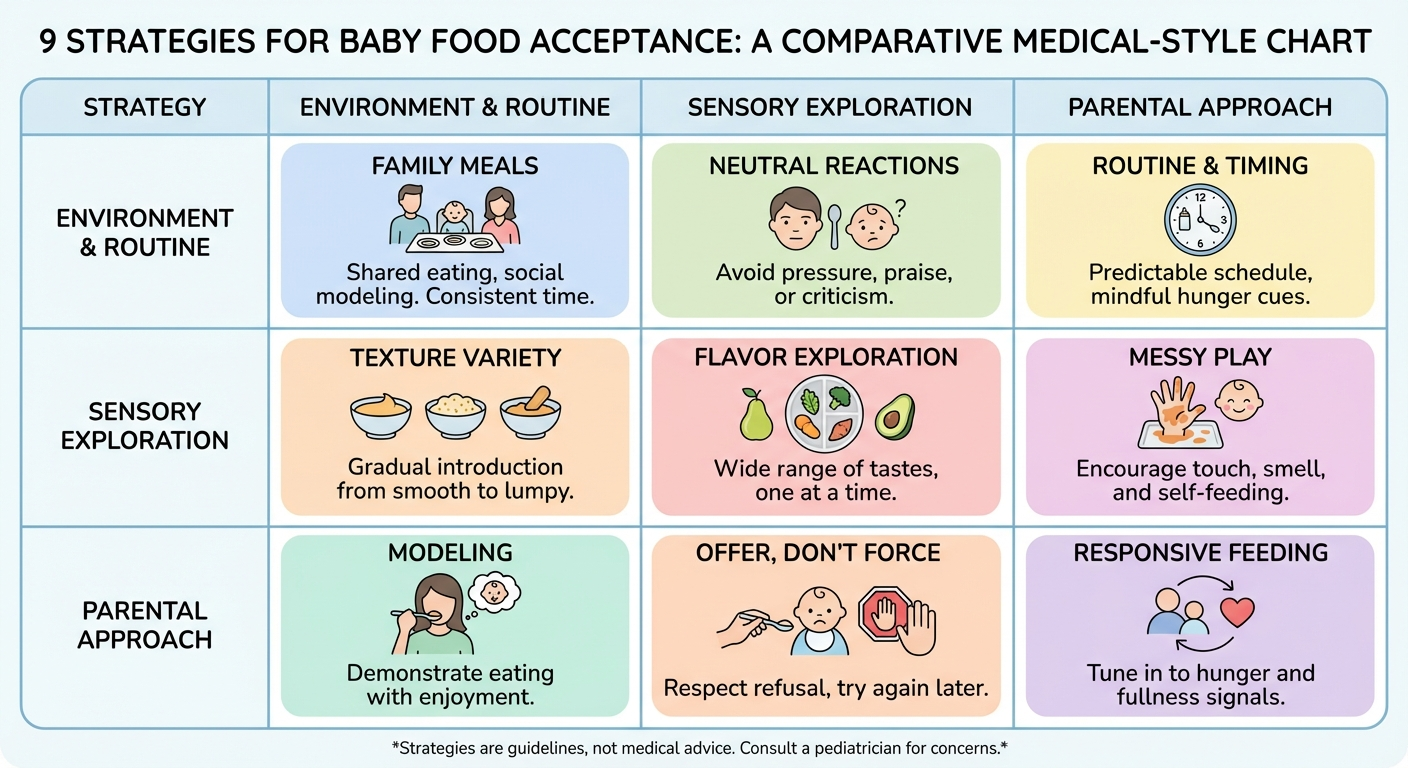
Where to Start: Top 3 Priorities for Most Families
If the list above feels overwhelming, focus on these three solutions first:
- Check readiness signs (#1) — rule out the simplest explanation before trying anything else
- Adjust your milk-to-solids timing (#2) — this single change resolves the issue for many families within days
- Offer food without pressure (#4) — creating a calm, low-stakes mealtime environment is the foundation that makes every other strategy more effective
Our recommendation: Start with these three for one to two weeks before layering in the remaining strategies. Most families see meaningful progress within this timeframe.
When to See a Doctor

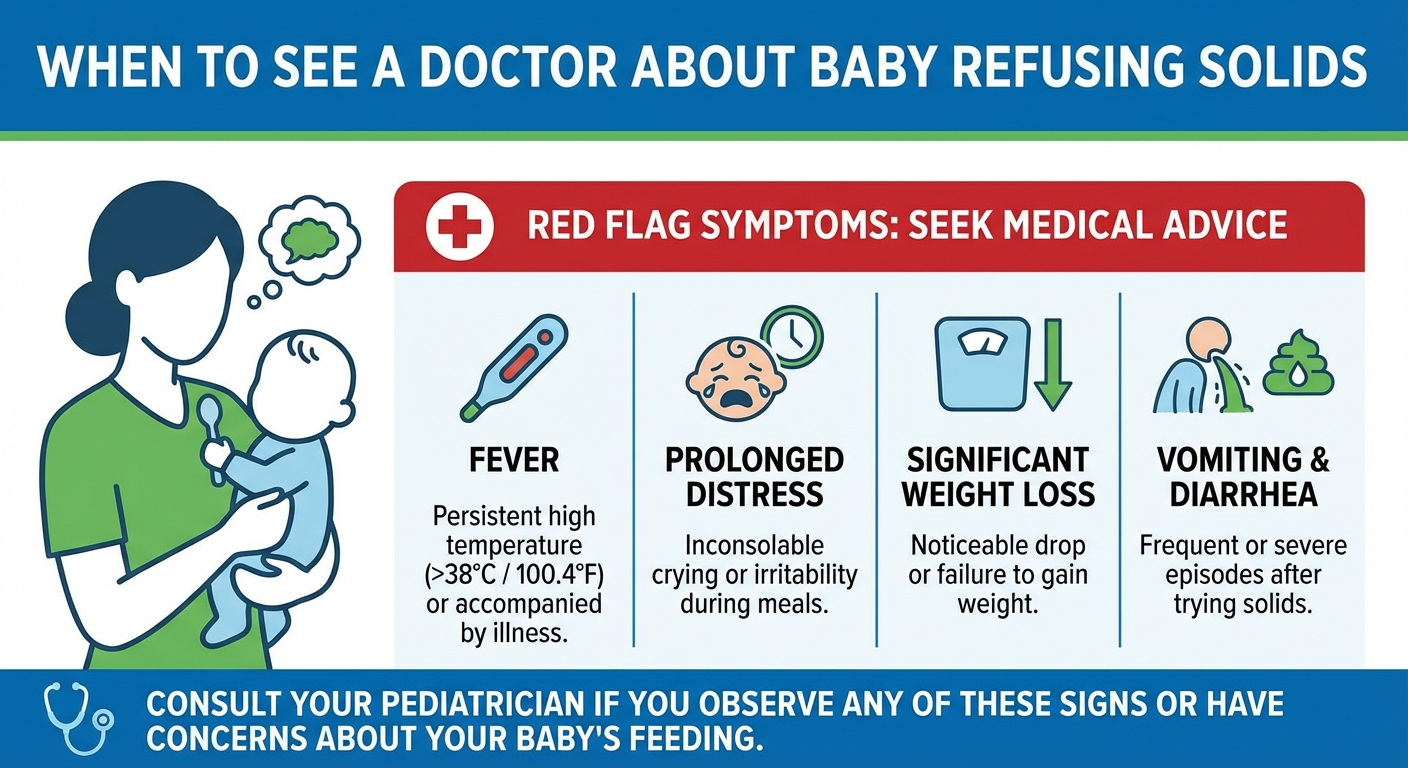
While most babies work through solid food refusal on their own timeline, there are situations where professional support is important. Trust your instincts — you know your baby best.
Contact your paediatrician or a paediatric dietitian if:
- Your baby is older than 8 months and consistently refuses all solids despite regular, gentle exposure over several weeks
- Your baby is losing weight or their growth has stalled or dropped off their established curve
- There is excessive gagging, choking, or vomiting at every single meal
- Your baby shows signs of pain or distress during feeding (arching, crying, pulling away)
- You notice difficulty swallowing, persistent drooling, or breathing changes while eating
- Your baby has not progressed beyond very smooth purees by 9 to 10 months
- There is a known history of prematurity, developmental delay, or medical conditions that may affect feeding
These situations do not necessarily mean something is seriously wrong, but they do warrant investigation. A feeding therapist, speech and language therapist, or paediatric dietitian can assess whether there is an underlying issue such as oral-motor delay, sensory processing differences, or silent reflux.
Early intervention leads to better outcomes, so do not wait and worry in silence.
Frequently Asked Questions
Is it normal for a baby to refuse solids at 6 months?
Yes, completely normal. The 6-month mark is a guideline, not a deadline. Many babies need a few extra weeks to develop the motor skills, sensory tolerance, and curiosity needed to accept solid food. If your baby is healthy, growing well, and still receiving adequate breast milk or formula, there is no need to panic. Keep offering food gently and watch for readiness signs.
How long should I keep trying if my baby refuses solids?
Research suggests it takes 10 to 15 exposures for a baby to accept a new food. Continue offering solids once or twice a day without pressure for at least two to three weeks. If your baby is still refusing all food consistently after a month of gentle, regular attempts, it is worth booking an appointment with your paediatrician or a paediatric dietitian to rule out underlying issues.
Should I stop breastfeeding or reduce formula to get my baby to eat solids?
No. Breast milk or formula should remain the primary nutrition source until 12 months. Cutting milk feeds too early can create nutritional gaps and increase mealtime anxiety. Instead, adjust the timing — offer solids 30 to 60 minutes after a milk feed so your baby is comfortable but not completely full.
Can teething cause a baby to refuse solids?
Absolutely. Teething causes swollen, tender gums that can make chewing and swallowing uncomfortable. During active teething episodes, it is common for babies to temporarily refuse solids or go back to preferring smoother textures. Offer chilled purees, cold yoghurt, or frozen fruit in a mesh feeder to soothe gums while keeping up food exposure. Once the tooth breaks through, appetite usually returns.
What are the signs I should see a doctor about my baby not eating solids?
Seek professional advice if your baby is over 8 months and refusing all solids, is losing weight or falling off their growth curve, gags or vomits excessively at every meal, shows signs of pain during feeding, or has difficulty swallowing or breathing while eating. A paediatric dietitian or feeding therapist can assess for issues like oral-motor delay, sensory processing differences, or reflux.
Does baby-led weaning help with food refusal?
It can. Some babies who reject spoon-feeding will engage with food more readily when they are allowed to self-feed. Baby-led weaning gives your baby autonomy over what and how much they eat, which can reduce mealtime pressure. However, it is not a guaranteed fix — some babies still need time regardless of the approach. You can also combine both methods. Read our full comparison of baby-led weaning vs purees to decide which approach suits your family.
My baby used to eat solids but has suddenly stopped. Why?
Regression is common and usually temporary. Common triggers include teething, illness, a developmental leap (like learning to crawl or walk), a change in routine (travel, new childcare), or a phase of asserting independence. Continue offering food without pressure, maintain your routine, and give it time. If the regression lasts longer than two to three weeks with no improvement, consult your healthcare provider.
Sources and Methodology
This article is informed by the latest evidence-based guidelines from leading paediatric and nutrition organisations:
-
World Health Organization (WHO): Recommends exclusive breastfeeding for the first 6 months of life, with the introduction of nutritionally adequate and safe complementary foods at around 6 months alongside continued breastfeeding up to 2 years or beyond.
-
American Academy of Pediatrics (AAP): Supports introducing complementary foods at around 6 months when developmental readiness signs are present. Emphasises responsive feeding practices and advises against pressuring children to eat.
-
European Society for Paediatric Gastroenterology, Hepatology and Nutrition (ESPGHAN): Recommends complementary foods should not be introduced before 4 months and should not be delayed beyond 6 months. Highlights the importance of iron-rich foods and varied textures during the complementary feeding period.
-
Birch, L.L., & Fisher, J.O. (1998). Development of eating behaviors among children and adolescents. Pediatrics, 101(Supplement 2), 539-549. Key finding: parental pressure to eat is consistently associated with lower food acceptance in children.
-
Maier, A.S., et al. (2007). Effects of repeated exposure on acceptance of initially disliked vegetables in 7-month-old infants. Food Quality and Preference, 18(8), 1023-1032. Key finding: repeated exposure (up to 10 times) significantly increases acceptance of novel foods in infants.
-
NHS Start4Life Weaning Guidelines (2025). Practical guidance on introducing solids, recognising readiness signs, and managing common weaning challenges.
All recommendations in this article align with current clinical consensus. Where I share advice from my own clinical experience, it is clearly identified as such and is consistent with the published literature above.
This article is for informational purposes only and does not replace individualised medical advice. If you have concerns about your baby's feeding or growth, please consult your paediatrician or a registered dietitian.